

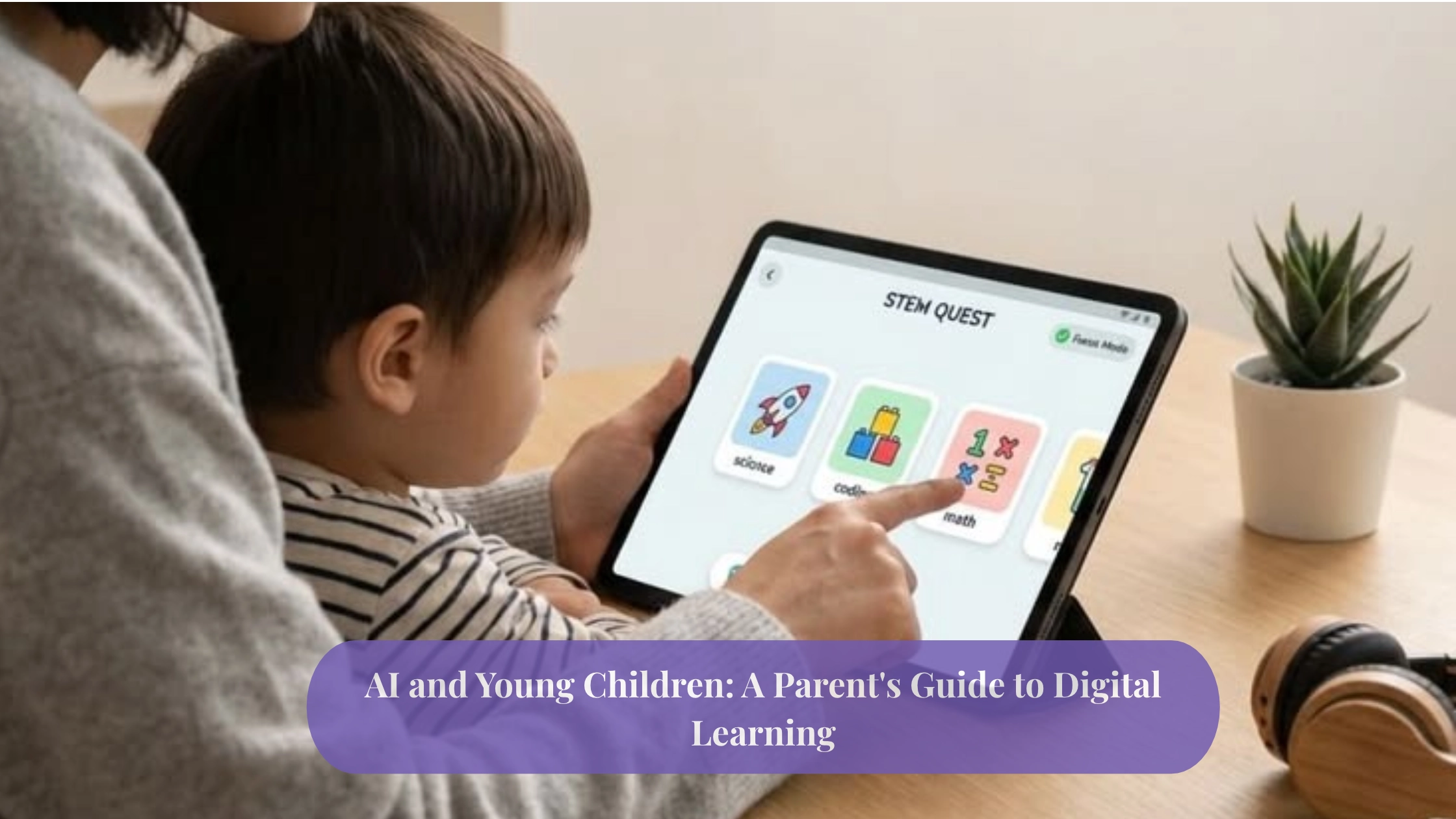
AI and Young Children: What Parents Should Know About Digital Learning explores how artificial intelligence can support early learning when used responsibly. For parents choosing a preschool in Abu Dhabi, understanding the benefits and limitations of AI-powered tools helps them balance digital activities with hands-on play, social interaction, and guidance from teachers and family members.
How Can AI Support Young Children’s Learning?
Artificial intelligence is becoming part of children’s learning through interactive storybooks, voice-based assistants, educational games, and personalised learning applications. These tools can adjust activities to a child’s pace, repeat lessons, and introduce concepts in engaging ways.
For example, an educational application may help a child recognise letters through sounds and pictures. Another may encourage counting using familiar objects. When used appropriately, these activities can make learning more engaging and give children opportunities to practise new concepts.
However, technology alone cannot provide the emotional connection, encouragement, and understanding that children receive from parents and teachers. Young children still need conversations, physical activities, and opportunities to explore their surroundings.
What Should Parents Know Before Introducing AI to Children?
Parents should consider the child’s age, developmental needs, and readiness before introducing AI-based learning tools. An application that works well for an older child may be unsuitable for a toddler who benefits more from sensory exploration and direct interaction.
Choose age-appropriate applications that offer clear educational value, simple navigation, and minimal advertising. Check whether the tool collects personal information, uses voice recordings, or includes external links. Avoid applications that encourage children to share names, photographs, locations, or other private details.
It is also important to understand that AI can sometimes provide incorrect information or responses that children may misunderstand. Young children should never be expected to evaluate AI-generated information independently. Parents and educators should guide them, explain unfamiliar concepts, and verify information when necessary.
How Much Screen Time Is Appropriate for Young Children?
The right amount of screen time depends on a child’s age, the content being viewed, and how technology fits into daily routines. Educational content does not automatically become beneficial simply because it appears on a screen.
For children younger than two, screen use should generally be very limited, with video calls being a notable exception. For children aged two to five, the World Health Organization recommends no more than one hour of sedentary screen time daily, with less being better. Parents should also follow current local paediatric guidance.
Families considering a Preschool in Abu Dhabi can ask how digital tools are used in classrooms, whether screen activities are supervised, and how teachers balance technology with outdoor play, storytelling, and hands-on learning.
A predictable routine can help children develop healthy habits. Keep mealtimes and the period before bedtime free from screens, and avoid using devices as the default response whenever a child feels bored or upset.
How Is AI Changing Early Childhood Education?
How AI Is Changing Early Childhood Education is an important question for parents evaluating modern learning environments. AI can help educators prepare learning materials, identify areas where children may need additional practice, and adapt activities to different learning needs.
For instance, a teacher may use digital resources to introduce shapes and colours before inviting children to identify those objects in the classroom. This combination connects digital learning with practical experience.
Parents looking for the Best Daycare in Abu Dhabi should focus on the overall quality of care and teaching rather than the number of technologies available. Ask whether educators supervise digital activities, protect children’s data, and use technology to support clear learning objectives.
AI should assist teachers, not replace their professional judgement or the relationships they build with children.
What Skills Do Children Need Beyond Digital Learning?
Technology is only one part of early childhood development. Children also need communication, creativity, emotional awareness, independence, physical coordination, and problem-solving skills.
These Skills Children Need to Learn at an Early Age develop through everyday experiences such as sharing toys, helping with simple tasks, listening to stories, building with blocks, and playing with other children.
At a Daycare in Shabiya 9, parents can ask how daily activities encourage social interaction, imaginative play, language development, and independent thinking alongside any digital learning.
At home, families can reinforce these skills by reading together, talking about emotions, exploring nature, drawing, and allowing children to solve small problems themselves.
How Can Parents Create a Healthy Balance Between AI and Play?
The most effective approach is to treat AI as an occasional learning resource rather than the centre of a child’s routine. Watch educational content together, ask questions about what the child sees, and connect screen-based activities with real experiences.
If a child learns about animals through an application, for example, encourage them to draw an animal, read a related story, or observe animals in a book or outdoor setting.
The goal is not to keep children away from all technology, but to help them use it safely and purposefully. With age-appropriate choices, active supervision, and plenty of real-world interaction, parents can support digital learning without losing sight of what young children need most: time to play, explore, connect, and grow.