

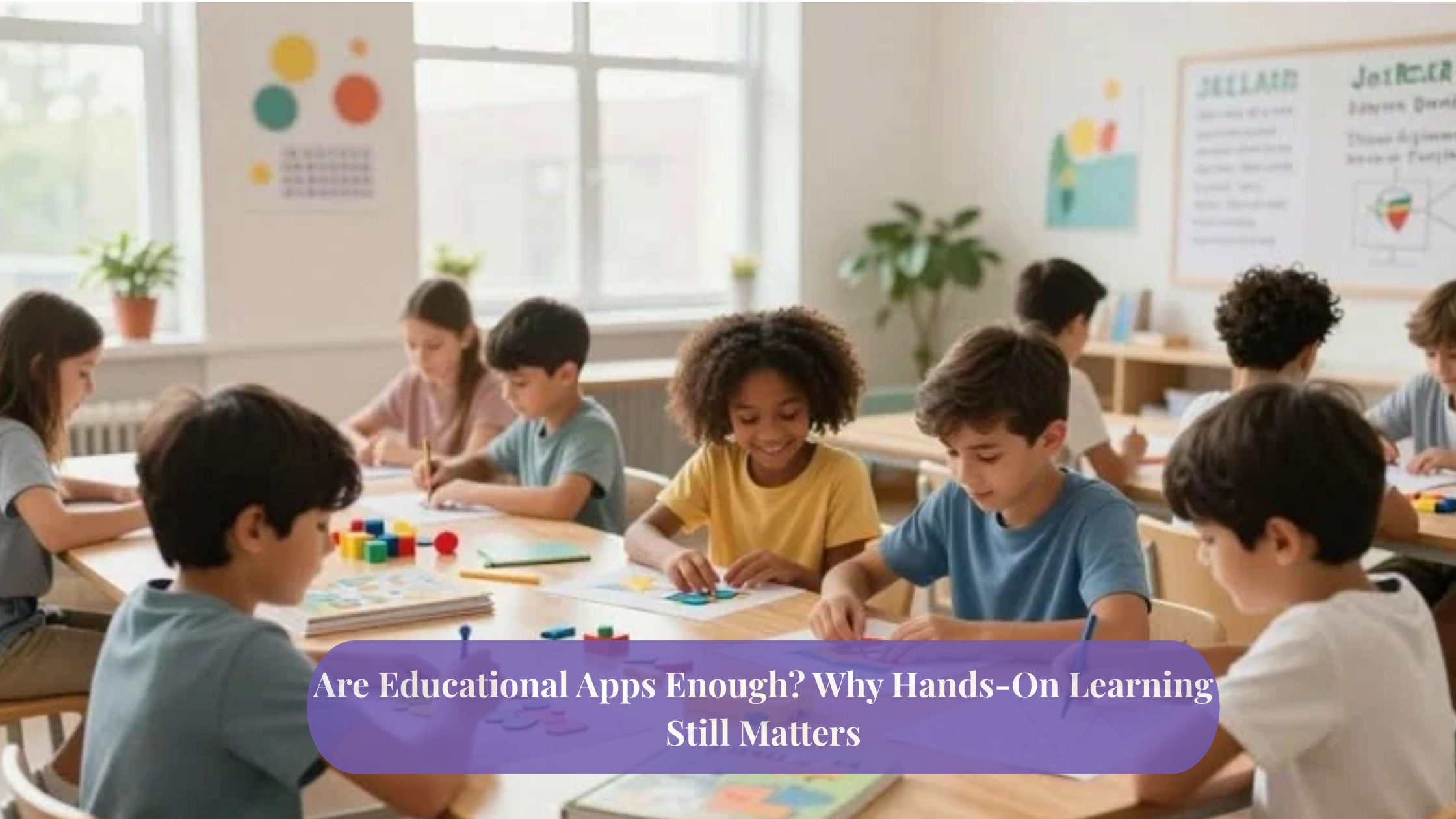
Are Educational Apps Enough? Why Hands-On Learning Still Matters explains why digital tools alone cannot meet every learning need of young children. Even at the best preschool in Musaffah, children need practical experiences such as building, drawing, exploring, and playing to develop creativity, communication, coordination, and problem-solving skills.
Can Educational Apps Support Early Childhood Learning?
Educational apps can make learning more interactive and enjoyable. Children can practise recognising letters, counting numbers, identifying colours, and understanding simple patterns through games, videos, and activities.
These tools can also allow children to repeat lessons at their own pace. When selected carefully and used with adult guidance, educational apps can support classroom activities and reinforce what children learn at home.
However, recognising an object on a screen is different from understanding how it works in real life. A child may learn about shapes through an application, but handling blocks and fitting them together provides a different kind of experience.
For this reason, parents searching for the best preschool in Musaffah should look beyond digital learning facilities and consider how the school encourages exploration, creativity, and practical activities.
Why Is Hands-On Learning Important for Young Children?
Young children learn naturally by touching, moving, observing, asking questions, and experimenting. Hands-on learning gives them opportunities to understand ideas through direct experiences rather than simply watching or listening.
For example, when children play with building blocks, they discover balance, size, shapes, and basic problem-solving. Painting helps them explore colours and express creativity, while gardening introduces them to plants, nature, and responsibility.
These activities also support physical development. Holding crayons, cutting paper with child-safe scissors, arranging objects, and playing with puzzles help strengthen fine motor coordination.
Hands-on learning connects knowledge with real experiences, making it easier for children to understand and remember what they discover.
What Skills Can Children Develop Through Practical Activities?
Practical activities support several areas of development at the same time. During group play, children learn to communicate, share materials, listen to others, and cooperate towards a common goal.
Creative activities encourage imagination and independent thinking. Simple experiments help children observe changes, make predictions, and discover answers. Outdoor play supports physical coordination while teaching children about their surroundings.
These experiences are especially valuable in the early years because children are developing the foundations for future learning.
Parents considering a KG school MBZ can ask teachers how classroom activities support language development, social interaction, creativity, and independent thinking instead of focusing only on worksheets and digital lessons.
How Can Parents Balance Educational Apps and Hands-On Activities?
A healthy learning routine does not require parents to completely avoid technology. Instead, the goal should be to use digital resources as a supplement to real-world experiences.
For example, after using an educational app to learn about animals, parents can encourage children to draw their favourite animal, read a related story, or observe animals in nature.
Similarly, a nursery in MBZ should provide opportunities for storytelling, sensory play, music, outdoor exploration, and group activities alongside any digital resources.
At home, parents can involve children in simple everyday tasks such as sorting toys, watering plants, preparing age-appropriate snacks, and organising books. These small experiences teach useful concepts while encouraging independence.
The best learning routine combines guided digital activities with plenty of opportunities to play, explore, and interact.
How Should Parents Choose a Learning Environment for Their Child?
When thinking about how to choose the best kg for your child, parents should consider the school’s teaching approach, classroom environment, teacher experience, safety, and opportunities for practical learning.
Observe how children spend their time. Are they encouraged to ask questions? Do they participate in creative activities? Is there enough space for movement and social interaction? Do teachers guide children patiently instead of expecting them to learn everything through screens?
Understanding The Importance of Early Childhood Education also helps parents recognise why these early experiences matter for a child’s long-term development.
A good early learning environment should support the whole child, including emotional, physical, social, and intellectual growth.
Can Technology Replace Real Learning Experiences?
Educational apps are useful tools, but they cannot replace the value of human interaction, physical exploration, and imaginative play. Children need opportunities to make mistakes, try again, communicate with others, and discover things independently.
Technology can support learning, but meaningful experiences help children understand the world around them. When parents and educators create a balance between digital resources and hands-on activities, children gain a stronger foundation for lifelong learning.